
Wasp Control That Starts With Identification, Not Guesswork


Paper wasps under an eave, yellowjackets coming out of a hole in the yard, and mud daubers plastering the garage door track all get lumped together as "wasps" — but they're not the same problem. Before we talk treatment, we look at which one you actually have, where the activity is coming from, and how defensive it's likely to be. Gingerly is family-owned and owner-led, and every property gets the same inspection-first approach no matter who's on the truck.
What Kind of Wasp Are You Dealing With?
Wasp activity tends to show up fast once the weather warms — a nest that was a few cells in May can be the size of a grapefruit by August, and warmer weather generally means more foragers out and about. That's usually why the calls start: not because something's suddenly gone wrong, but because a colony that's been quietly building all season finally becomes hard to miss.
Not every wasp around a home is the same insect, though, and the differences matter. Paper wasps, yellowjackets, and mud daubers look different, nest differently, and range widely in how defensive they get if you get close. Figuring out which one you're actually looking at — and where the activity is really coming from — is the first real step, before anyone talks about treatment.
Paper Wasps
Paper wasps are the ones most people picture — slender, long-legged, usually brownish with yellow or reddish markings. They build an open, umbrella-shaped comb you can see the individual hexagonal cells on, with no outer covering, usually tucked somewhere protected: under eaves, along rooflines, in porch ceiling corners, inside sheds, or under patio furniture and grills that don't get moved often. A paper wasp nest left alone usually stays fairly small and quiet, but the wasps can turn defensive fast if the nest itself gets bumped, sprayed, or knocked — which is what leads to most stings, more than just wasps passing by.

Yellowjackets
Yellowjackets are shorter and stockier than paper wasps, with tighter black-and-yellow banding and a faster, more erratic flight pattern. Where they nest is the bigger difference: instead of an exposed comb out in the open, yellowjackets typically build inside a cavity — underground in an old rodent burrow or similar hole, or inside a wall void, attic space, or other structural gap. That's why you can have a yard with real yellowjacket traffic and never actually spot a nest — the entrance might be a single hole in the lawn or a gap you'd never think twice about. A mature yellowjacket colony can hold thousands of workers, and they're considerably more defensive than paper wasps once the colony feels threatened, especially later in the season when colonies are at their largest.
Mud Daubers
Mud daubers look different from either — noticeably slender, almost thread-waisted, often a solid dark color or metallic blue-black. Instead of a paper comb, they build hard mud tubes or clusters of mud cells, usually in the same kind of protected spots: garage corners, eave undersides, porch ceilings, and sheds. Mud daubers are solitary — there's no colony to defend — and they're generally not aggressive toward people at all. Finding a mud nest on the house isn't the same situation as finding an active yellowjacket colony, even though people often assume it is.


Where Wasps Actually Build Nests Around a Home
Eaves, rooflines, doorway corners, window frames, sheds, fence posts, and the undersides of decks and patio furniture all check the same boxes for a nest-building wasp: protected, elevated enough to feel safe, and usually somewhere that doesn't get disturbed very often. Paper wasps and mud daubers build right on these surfaces, out in the open once you know where to look. Yellowjackets are the exception — an old rodent hole, a gap under a slab, a void behind siding, or a gap around a utility line can all lead to a colony you'd never spot from the surface.

That's also why a property can have obvious yellowjacket activity — wasps flying a consistent path in and out of one area — without an obvious nest anywhere nearby. The entrance is often small, low, and easy to miss, especially if it's in mulch, ground cover, or a gap you wouldn't think to check. Finding the actual source matters, because treating around where wasps are foraging does very little if the colony itself is somewhere else entirely.
Why Wasps Keep Coming Back to the Same Spot
A structure that supported one nest usually has the same conditions the next season — same protected eave, same undisturbed shed corner, same gap around the same vent. That's most of the reason activity seems to return to a familiar spot year after year: the location was good for a wasp once, and nothing about it changed. An old, abandoned nest itself doesn't need to still be there for a new one to show up nearby.
Foothill properties around Auburn and similar communities, with more open ground, oak leaf litter, and undisturbed soil, tend to see more ground-nesting yellowjacket activity. Tighter suburban lots more often see paper wasp and mud dauber activity concentrated on the structure itself — eaves, garages, and patios — simply because there's less open ground available to nest in.

How We Approach a Wasp Call
We don't treat every nest the same way, because they're not the same situation. Species, location, how accessible the nest actually is, how much activity is present, and the conditions around the property all factor into what makes sense. An exposed paper wasp nest under a porch eave is a different job than a yellowjacket colony coming out of the ground near a walkway, and we're not going to pretend otherwise or promise the same process for both.
Does Killing the Wasps You See Solve Anything?
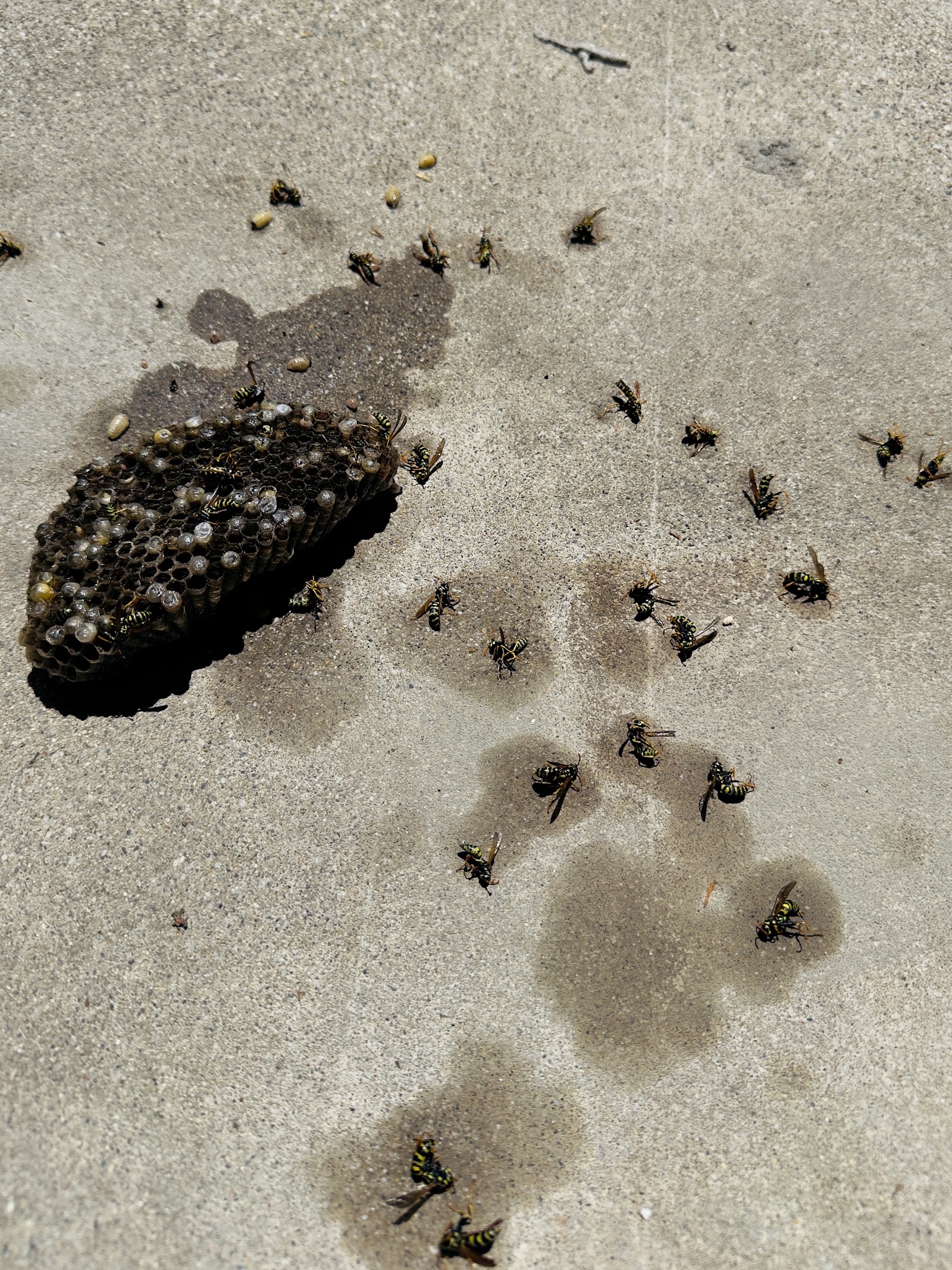
Not usually, and it's the same idea that applies to ants or other colonizing insects: swatting or spraying the individual wasps you can see doesn't do much if the nest itself is untouched. Paper wasp and yellowjacket colonies keep producing workers as long as the nest is intact and the queen is alive. A handful of dead wasps on the patio doesn't tell you much about whether the colony behind them is still active.
Should You Knock Down a Nest Yourself?
It depends entirely on what it is. A small, inactive mud dauber nest is generally low-risk to remove yourself. An active paper wasp nest or anything that looks like a yellowjacket entrance is a different story — both can respond fast and defensively once disturbed, and a ground or void-nesting yellowjacket colony in particular can be far larger than what's visible from the outside. If you're not confident what you're looking at, that uncertainty itself is a reason to have someone take a look before doing anything to it.
What to Realistically Expect
We're not going to tell you that you'll never see another wasp on the property — that's not realistic outdoors, especially during the warmer months when activity is at its highest. Routine wasp activity around a home is something our regular general pest control service already accounts for as part of ongoing exterior treatment. Recurring general pest control starts at $199 for the initial service and typically around $60 a month after that, with no long-term contract, and visits are usually every 60 days. Larger established nests, active yellowjacket colonies, or ground-nesting activity are usually enough to warrant a closer look and a more specific plan, since they call for a different approach than routine perimeter service. Those are quoted separately once we see what's there. Either way, the goal is figuring out what's actually there and responding to that — not defaulting to the same response for every wasp that shows up. More detail is in our pest control cost guide.
Helpful reading: how to find wasp nests in Placer County and a wasp nest job in Foresthill.
Do You Have Questions?
Should I knock down a wasp nest myself?
It depends on what you're looking at. A small, inactive mud dauber nest is generally fine to knock down yourself. An active paper wasp nest, or anything that looks like it could be a yellowjacket entrance, is riskier — both can turn defensive quickly once disturbed, and a yellowjacket colony can be much larger underground or inside a structure than what you can see from outside. If you're not sure what you're dealing with, that's reason enough to have someone look at it first.
Are mud daubers dangerous?
Generally, no. Mud daubers are solitary — there's no colony to defend — and they're not aggressive toward people the way social wasps like yellowjackets can be. They can still sting if handled directly, but finding a mud nest on your house isn't the same kind of situation as finding an active yellowjacket colony, even though the two often get lumped together.
Does killing individual wasps solve the colony problem?
Not usually. Swatting or spraying the wasps you can see doesn't do much if the nest itself is untouched — paper wasp and yellowjacket colonies keep producing new workers as long as the nest and queen are intact. A few dead wasps on the patio doesn't tell you much about whether the colony behind them is still active.
How much does wasp control cost?
Routine wasp activity, like paper wasps and mud daubers around the house, is covered by our recurring general pest control, which starts at $199 for the initial service and typically around $60 a month after that, with no long-term contract. Larger nests and yellowjacket colonies are quoted separately once we see what's there, since location and access change the job a lot.
When should I call a pest control professional for wasps?
It's worth a call when a nest is active and in a spot you can't safely avoid — near a door, walkway, or somewhere kids or pets pass by regularly — when you're seeing yellowjacket activity but can't find where it's coming from, or when a nest has been building for a while and is larger than something you want to handle yourself. Ground-nesting and void-nesting yellowjacket colonies in particular are usually best left to an inspection rather than a guess.
Get A Quote — Fast, Friendly, And No Pressure
Tell us a little about what’s going on, and we’ll get back to you quickly with honest pricing and clear next steps. No pushy sales stuff, no hidden fees—just real help when you need it.
Monday
8 AM - 6 PM
Tuesday
8 AM - 6 PM
Wednesday
8 AM - 6 PM
Thursday
8 AM - 6 PM
Friday
8 AM - 6 PM
Saturday
Closed
Sunday
Closed