
How Do I Know If I Have a Wasp Nest on My Property?
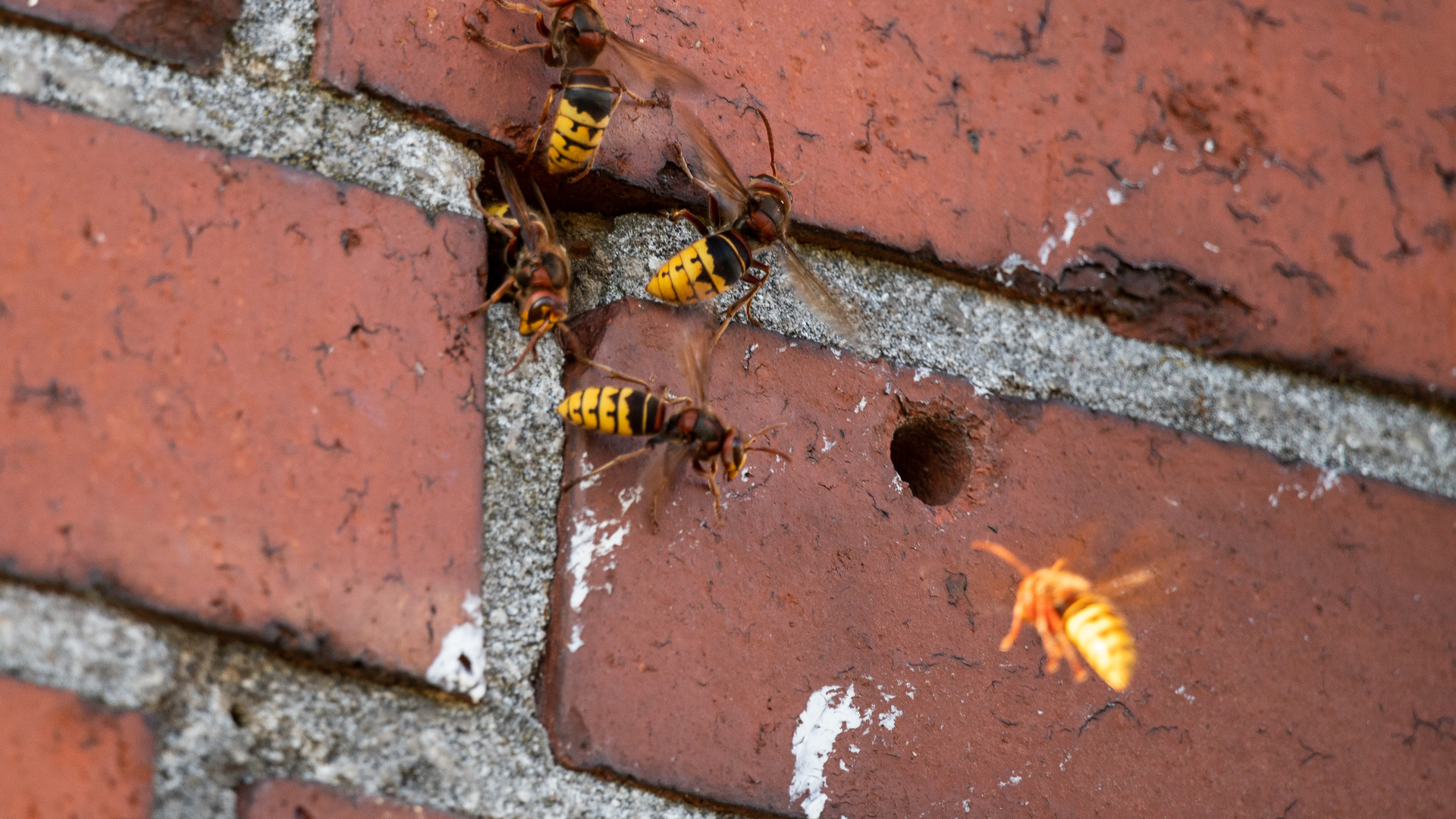
A wasp nest on your property usually shows up as a gray papery structure tucked under eaves, in shrubs, or in the ground. In July and August, Placer County homeowners are most likely to encounter yellow jackets and paper wasps. If you can see the nest from a safe distance and wasps are actively flying in and out, it's time to call a pro. Disturbing a nest without the right equipment puts you at risk of dozens of stings.
How Do I Know If I Have a Wasp Nest on My Property?
You notice wasps a few times near the roofline. Then a few more. By mid-July, they're returning to the same spot under the eave every time you walk past, and you're starting to wonder if there's something up there you can't see. There usually is.
By midsummer, a nest that was barely noticeable in May can house several hundred wasps. July and August are when Placer County colonies hit full size and when a nest that felt manageable stops feeling that way. This post covers what you're looking at, where to look, and when to step back and call someone.
Where Do Wasps Build Nests, and What Do They Look Like?
Most homeowners don't go looking for a wasp nest until wasps start getting in the way. By that point, the nest has usually been there for weeks. Knowing the common construction sites on a typical Placer County property makes it easier to catch problems early, from a safe distance.
Eaves, Ground, and Shrubs: The 3 Most Common Spots
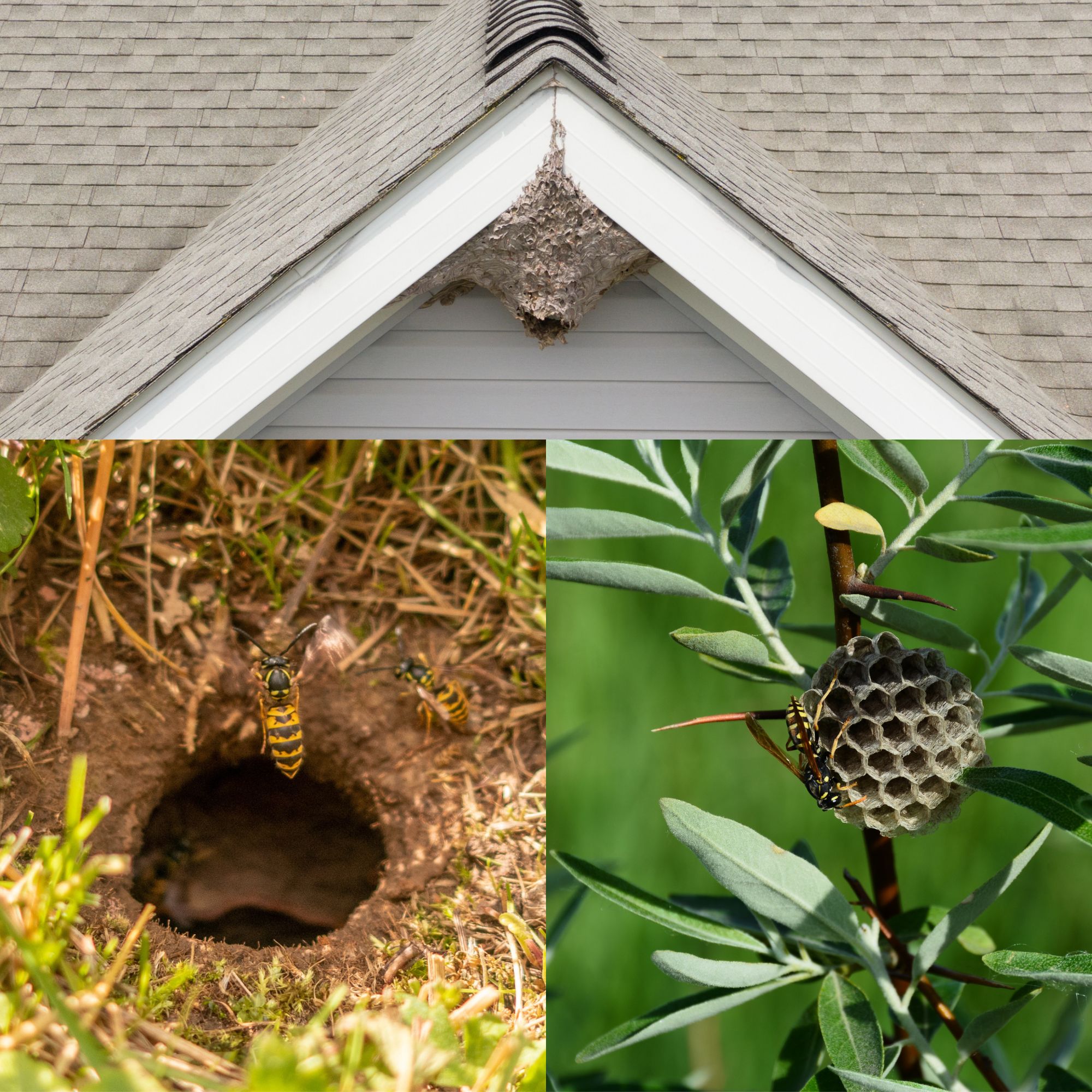
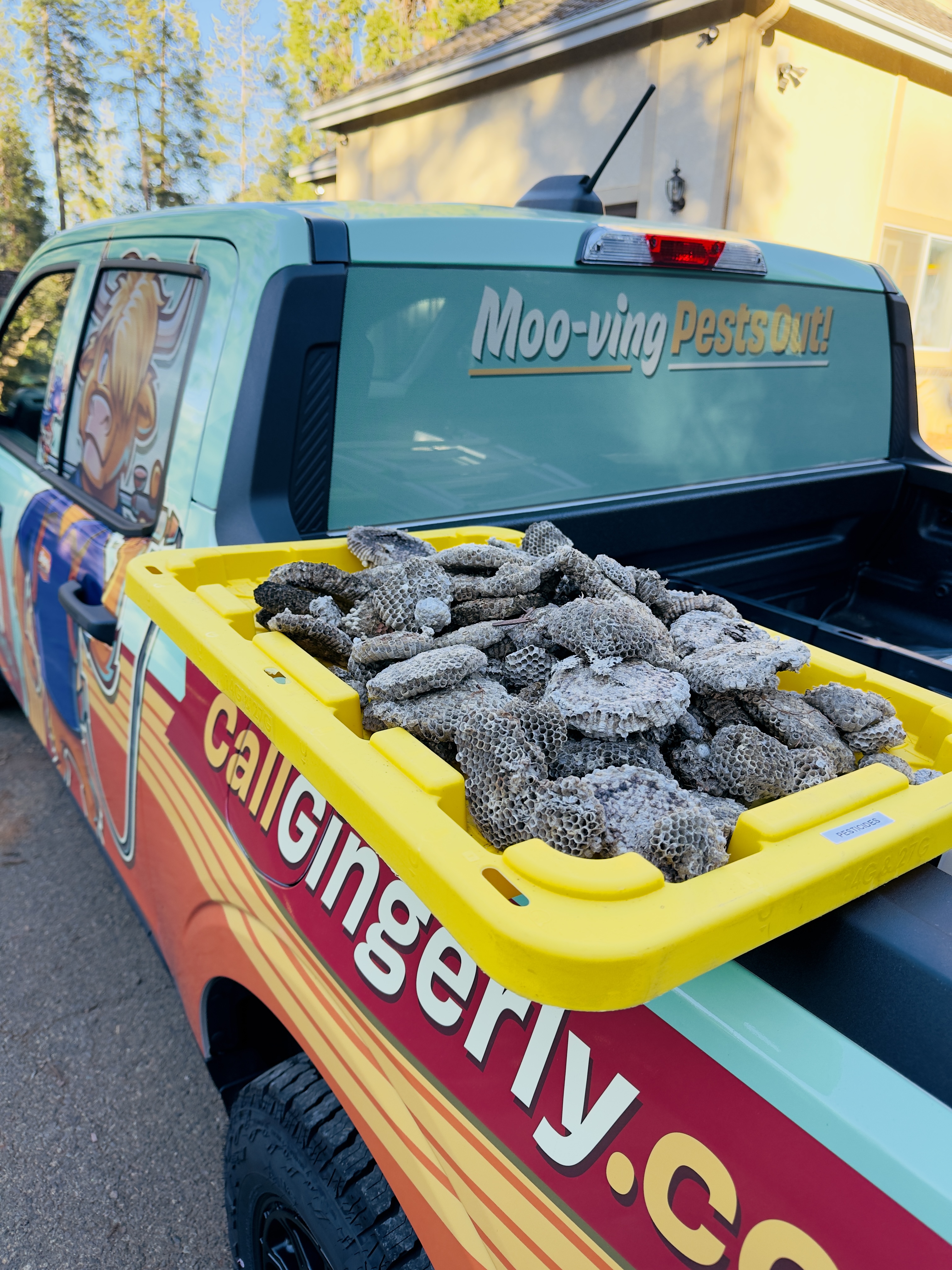
Under roof eaves and overhangs. Paper wasps are the most likely species here. The nest looks like an open honeycomb, gray, papery, about the size of a fist or larger, hanging from a short stalk with no outer shell. You can see the individual cells directly. They favor the underside of eaves, porch ceilings, and deck railings where there's shelter from rain.
In the ground or near wood piles. Yellow jackets are the ones building underground. A hole in the lawn, or one near a woodpile with wasps flying in and out, is the tell. The nest itself is hidden below the surface inside an enclosed papery structure, nothing visible from above until you're standing right over the entrance, which is exactly how people stumble into them.
In shrubs, trees, and wall cavities. Bald-faced hornets build large enclosed nests in trees and shrubs: gray, football-shaped, and easier to spot once the leaves thin out. Yellow jackets also nest inside wall cavities. The only sign is a small entry hole in the siding with wasps disappearing into it.
By late summer, a fully developed paper wasp nest can run 6 to 8 inches across, and a yellow jacket ground colony can contain thousands of workers.
Wasp vs. Yellow Jacket: Does It Matter?
It does, because yellow jackets and paper wasps behave differently, and that changes how much of a problem you have.
How to Tell Them Apart at a Glance
Paper wasps are slender, with long legs that hang visibly in flight. Brown with yellow markings. They're defensive near the nest but don't typically pursue unless you've made direct contact with it. A nest under your eave is a manageable situation compared to what yellow jackets bring.
Stockier build, brighter yellow-and-black, and a much shorter fuse. That's a yellow jacket. They don't need the nest to be touched to respond. A ground nest near a patio or play area is a different level of risk entirely because they'll pursue a perceived threat well away from the entrance and sting repeatedly in the process.
The foothill terrain around Auburn, Loomis, and Rocklin sees both species consistently through the summer. Nest location is the clearest tell when you're not sure which one you're dealing with. Up high under an overhang is almost always paper wasps, and in the ground is almost always yellow jackets.
Are Wasps Dangerous? When to Be Concerned?
Unlike bees, wasps can sting multiple times. A threatened colony doesn't run out of ammunition. That said, not every nest carries the same level of urgency.
Two Situations That Need Immediate Attention
The nest is within 10 feet of a door, patio, or play area. Normal foot traffic near the entrance is enough to provoke defensive behavior at that distance. Yellow jackets are especially reactive in this situation. If kids or pets regularly move through that area, don't wait for it to go south before you respond.
Someone in your household has a known allergy to bee or wasp stings. A single sting from a disturbed nest can trigger anaphylaxis in sensitive individuals. If that applies to anyone in your home, nest size and location no longer matter. It needs to come down.
Outside those two situations, a small paper wasp nest in a low-traffic corner of the yard carries a lower immediate risk. Colonies grow fast in summer heat, though, and what's a minor issue in early July can be a serious one by August.
Can You Remove a Wasp Nest Yourself?
Sometimes, with the right conditions. A small paper wasp nest, fewer than 10 wasps, early in the season, easy to access, and away from foot traffic, can sometimes be handled with a store-bought wasp spray.
Treat at night. Wasps are slower when temperatures drop. By this time, most of the colony is inside the nest, which means the spray reaches more of them before anything can mobilize.
What Professionals Do Differently
The calculus changes with nest size, species, and location. A yellow jacket ground nest, anything inside a wall cavity, or any nest larger than a softball is a different situation:
- Full protective gear that covers the complete body, not just a can of spray aimed from a distance
- Product applied directly into the nest interior, not just at the entry point
- Follow-up inspection to confirm the colony is gone and the void is sealed so it doesn't get reoccupied
Attempting a large nest or a ground nest without the right gear is how people end up in the emergency room. The mechanics of a disturbed colony are faster than most people expect. You can read more about what happens when you wait too long to remove a wasp nest and why timing matters.
Got a Wasp Nest? Get It Handled Now.
July and August are when wasp colonies are at full strength, and the risk of a bad encounter is highest. If you've spotted a nest or you're seeing wasps returning to the same spot on your property, we can take a look and handle it before it becomes a bigger problem.
Contact us through our pest control services page to schedule an inspection.
We serve homeowners across:
.jpg)






.jpeg)