Rat & Mouse Control · Interior Trapping

Rat and Mouse Trapping in Placer County

Effective trapping starts with knowing where the activity actually is, how rats or mice are moving through the structure, and what's keeping them around. We inspect first, then build a trapping plan around what we find, not a one-size-fits-all setup.

When Rat and Mouse Trapping Makes Sense

Trapping is the tool we reach for when rats or mice may already be inside a structure: an attic, a crawlspace, a wall void, a garage, or even a cabinet. It's a different job from managing the rat and mouse population living outside a home.

Exterior work, like secured bait stations, is about reducing pressure around a property over time. Interior trapping is about the rats or mice that are already inside right now. Most of our trapping happens in attics and crawlspaces, since that's where rodents most often travel and nest once they've found a way in. Unless we see evidence that activity has moved into the occupied living space, such as droppings, disturbed food packaging, sightings, or sounds coming from inside a wall or cabinet, we generally keep trapping out of the rooms you actually live in.

Every property is different, so where we start depends on what the inspection turns up.

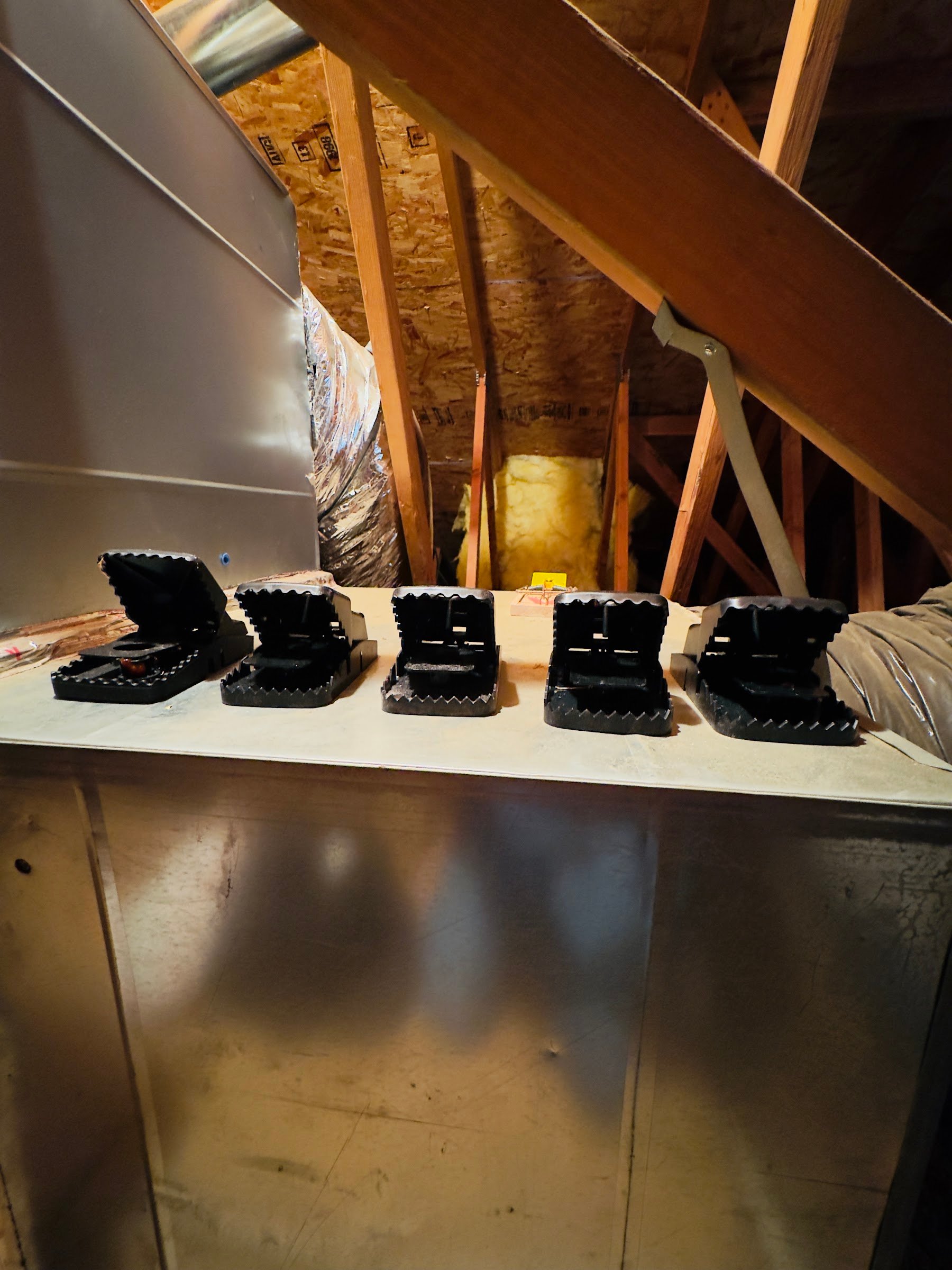
Rodent snap traps set along an attic beam by Gingerly Pest Control

Inspection Comes Before Placement

We start by listening. Where have you heard movement: in the ceiling, inside a wall, under the floor, behind a cabinet? That conversation shapes where we look first.

Foundation type matters too. A home on a raised foundation with a crawlspace gives rats and mice a way to travel underneath the house and work upward through gaps and utility penetrations, while a slab foundation changes where those pathways are likely to be. We check for both, since entry and travel patterns are genuinely different between the two.

From there, we look for physical evidence: droppings, footprints, rub marks, drag marks, gnawing, and disturbed insulation or debris. Marks and tracks along HVAC ducting, PVC and ABS piping, gas lines, and other utility surfaces often tell us more about travel routes than anything else, since rodents tend to reuse the same paths.

None of this is perfect. We can't always reconstruct a travel route with full certainty, but this evidence gives trap placement a reason behind it instead of guesswork.

Gingerly technician inspecting a kitchen cabinet for signs of rats and mice in Loomis, CA
Before any traps go down, we look for droppings, gnaw marks, and travel paths to decide where they belong.

Strategic Trap Placement

We use plastic snap traps for both rats and mice. Compared to traditional wooden traps, we've found them more precise: they fit into tighter spaces, and they're less prone to triggering prematurely while we're getting them into position.

There's no fixed number of traps for a job. How many we use depends on the size of the home, how many likely access points and travel routes we find, and how much activity is present. A typical setup runs somewhere in the range of two to six traps.

Heavier activity or multiple travel routes can call for quite a few more.

Relying on a single trap is usually a bad bet: if it isn't sitting on the route a rat or mouse actually uses, it may never get triggered at all. Placing traps along the pathways the inspection points to, rather than wherever's convenient, is what makes the difference.

Securing Traps in Place

Depending on the location, we sometimes secure a trap with baling wire. This matters most where there's a real chance a captured rat could drag the trap somewhere we can't reach, deeper into an attic void, for example. It's a case-by-case call: some tight spaces, like underneath a bathtub, don't leave a practical place to anchor anything, so not every trap gets wired down.

Protective Stations Around Children and Pets

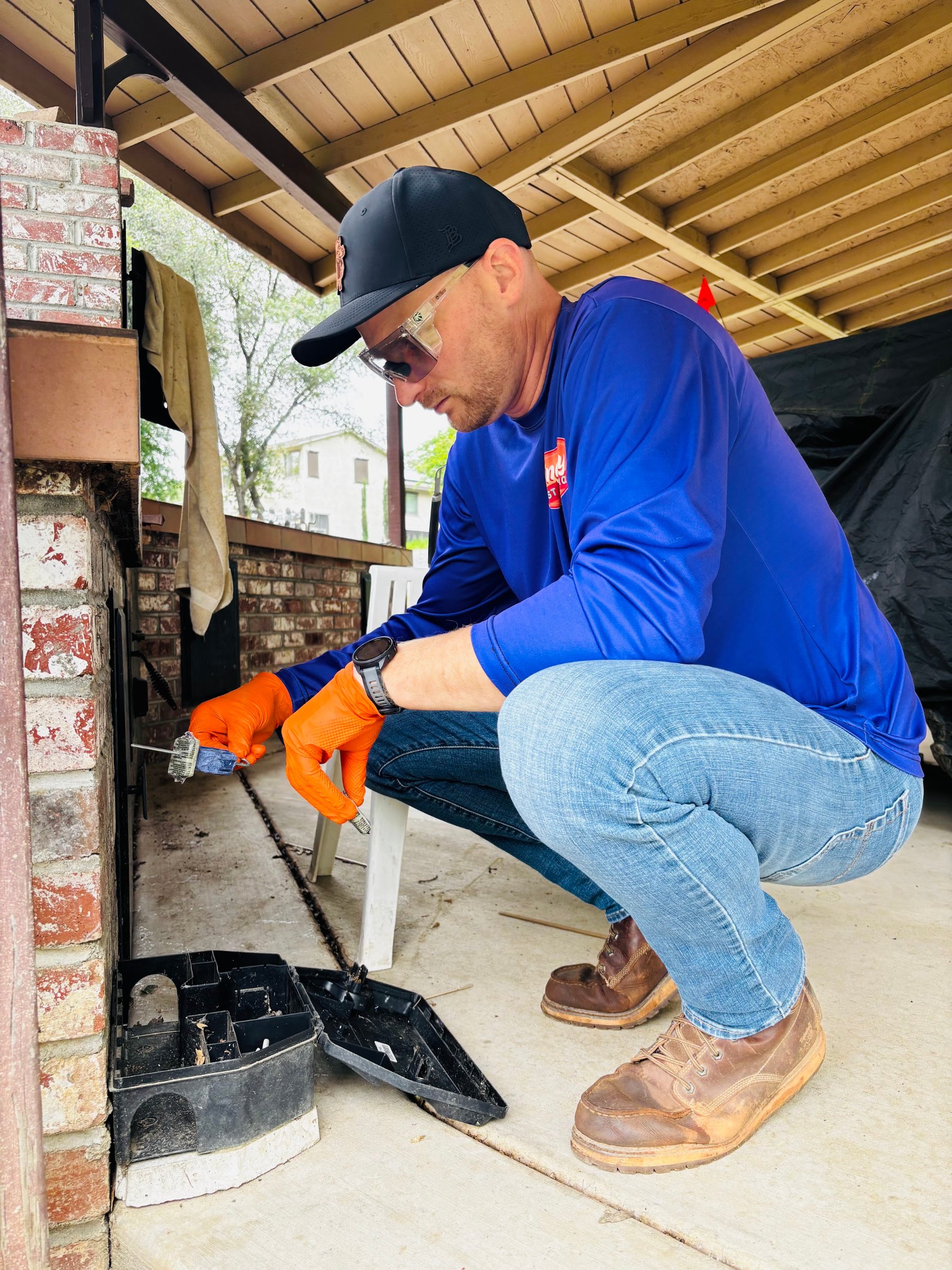
When a trap needs to go somewhere inside the occupied part of a home and kids or pets could reach it, we place it inside a locked protective station instead of leaving it exposed. That's a judgment call we make on-site, based on where the activity is and who has access to the area.

Gingerly technician servicing a locked protective rodent station on a covered patio
Protective stations may be used when trap access needs to be restricted around children or pets.

What Happens After Traps Are Set

We generally schedule the first follow-up within two to three weeks of the initial visit. Rats especially can be cautious around anything new in their environment, so it sometimes takes a little time before one approaches a freshly placed trap. Mice tend to move faster and often interact with traps sooner, but every home and every rodent is a little different, and we don't treat that as a guarantee either way.

If you notice a capture before your scheduled follow-up, let us know and we'll try to get back out sooner to remove it and reset.

At every follow-up, we're not just checking traps, we're reevaluating. Based on what we find, traps might get reset, rebaited, moved to a new spot, added, or removed if a location clearly isn't seeing activity. We can't promise an exact timeline for when trapping will be finished; it depends on what the evidence keeps telling us.

How Trapping Fits Into a Complete Strategy

Trapping removes the rats and mice that are already inside, but it isn't meant to stand alone. It works best as one part of our full rodent control service, which also looks at how they're getting in and what's drawing them in the first place.

Why We Don't Always Seal Entry Points Right Away

It seems logical to seal up every gap the moment we find it, but timing matters more than people expect. If we know or suspect there's still activity inside a wall void or another enclosed space, sealing the exterior opening too soon can trap that activity in a space it can't get back out of. In cases like that, we'll typically hold off on that specific point until trapping and monitoring tell us it's clear, then handle rat and mouse exclusion as its own step. Other entry points with no evidence of current use can often be sealed right away. It's a case-by-case call based on what the inspection actually shows, not a blanket rule in either direction.

Exterior Trapping vs. Exterior Bait Stations

Exterior trapping has its place, but it isn't the main tool we lean on outside the home. Rats and mice roam a wider territory outdoors, so a fixed trap is less likely to be in the right spot at the right time compared to inside, where travel paths are narrower and more predictable. That doesn't make exterior trapping useless, just more limited. For ongoing exterior pressure, locked exterior bait stations are usually the more practical long-term tool, since they stay in place and keep working between visits rather than depending on a rodent crossing one specific spot.

What Helps Trapping Work Faster

Traps compete with whatever else is available to eat. Pet food left out overnight, birdseed, fallen fruit, and accessible trash all give rats and mice reasons to ignore a trap. Reducing those competing food sources around the property is one of the most effective things a customer can do to help trapping succeed faster, alongside the exclusion and exterior bait station work we handle.

Rural and Suburban Rat-and-Mouse Pressure

Placer County covers a wide range of properties, and rats and mice don't limit themselves to one kind of setting. Both rural and suburban homes see real pressure, just from somewhat different sources.

Rural Properties

Larger lots, outbuildings, dense vegetation, and nearby agricultural or open land all give rats and mice more cover and more ways to approach a home. Barns, sheds, woodpiles, and vehicles in storage can all become staging areas before rodents move toward the house itself.

Suburban Properties

Closer-together homes, fence lines, shared landscaping, and easy access to pet food, trash, and gardens create their own steady food and shelter sources. Mature landscaping and block-wall fencing in particular give rodents a consistent, sheltered travel route between properties.

Neither setting is automatically worse than the other. What matters is what's actually present on a given property, which is why the inspection comes first.

Rat and Mouse Trapping Pricing

Trapping starts at $399. Every property is different, so the final price depends on what we actually find at your home.

Trapping starts at

$

399

Includes one follow-up visit; $125 for each additional visit if needed

What's Included

Inspection and evidence-based trap placement

Plastic snap traps only, no poison used indoors

Typically 2 to 6 traps depending on activity

Traps secured or placed in protective stations when needed

One included follow-up visit, generally 2 to 3 weeks out

Guidance as part of our complete rodent control approach

Rat and Mouse Trapping FAQs

How many traps will you actually set in my home?

There's no fixed number. Most jobs use two to six traps, though larger or more active spaces occasionally need more. We place traps based on what the inspection shows, not a preset count.

Where do you actually put the traps?

Interior trapping is usually focused on attics and crawlspaces unless we find evidence of activity in living spaces. We look at foundation type, droppings, rub marks, and utility-line pathways to decide exactly where to place each trap.

How long does trapping take to work?

It varies. Rats can be cautious around anything new, so they sometimes take longer to approach a trap than mice do. We generally schedule the first follow-up two to three weeks out, but we don't promise an exact timeline since it depends on what the evidence tells us along the way.

Will you use locked, protective stations?

When needed, yes. If traps need to be placed somewhere accessible to children or pets, we use locked protective stations to restrict access to the trap itself.

Do you secure traps in place?

Sometimes. In areas like open attic framing where a trap could be dragged into an inaccessible space, we may secure it with baling wire. It isn't something we do on every trap or every job, it's based on the specific location.

Is the follow-up visit included in the price?

Yes, one follow-up visit is included in the starting price. If additional visits are needed beyond that, each one is $125.

Will you seal up entry points right away?

Not always immediately. If there's reason to think a wall void or other enclosed space still has activity, sealing that specific opening too soon can trap it inside. We handle exclusion timing case by case based on what we find.

What can I do to help the traps work faster?

Traps compete with any other food source available. Bringing in pet food overnight, cleaning up birdseed and fallen fruit, and securing trash all reduce the competition and can help traps work faster.

Do you also trap outside, around the yard?

Occasionally, but it's not our main exterior tool. Rats and mice roam more widely outdoors, so a fixed trap is less likely to be in the right spot. For ongoing outdoor pressure, locked exterior bait stations are usually more practical.

What's the difference between exterior traps and exterior bait stations?

A trap only catches what crosses that exact spot. A locked bait station stays in place and keeps working between visits, which makes it a more consistent long-term tool for exterior rodent pressure.

Is trapping different for rural versus suburban homes?

The approach is the same, evidence-based placement, but what we find often differs. Rural properties tend to have more outbuildings and vegetation for cover, while suburban properties often see pressure from shared fence lines and accessible food sources. Both get inspected the same way.

Still have a question about trapping at your property?
Connect us

Hearing Movement in a Wall, Ceiling, Attic, or Crawlspace?

That kind of activity usually means it's time for an inspection, not a guess. We'll look at what's actually going on at your property and build a trapping plan around the evidence we find.

Contact Us

Get A Quote — Fast, Friendly, And No Pressure

Tell us a little about what’s going on, and we’ll get back to you quickly with honest pricing and clear next steps. No pushy sales stuff, no hidden fees—just real help when you need it.

Hours:

Monday

8 AM - 6 PM

Tuesday

8 AM - 6 PM

Wednesday

8 AM - 6 PM

Thursday

8 AM - 6 PM

Friday

8 AM - 6 PM

Saturday

Closed

Sunday

Closed

See our Privacy Policy for details on how we handle your information.
Thank you! Your submission has been received!
Oops! Something went wrong while submitting the form.